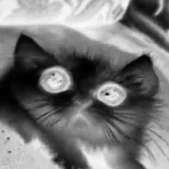
Eyes are the feature that people determine whether an object is alive or not. For puppets, their eyes are given by people. They belong to different identities, different societies, different cultures, different genres, different regions…… They are defined symbols.
Using the relationship between eyes and life as a clue, I reordered all styles of eye pictures using the order of the blinking motion. When a thousand symbolised objects flow and form a new symbol, it can no longer be defined by any single culture, society or concept. From its own change and flow, it is no longer solid, as if it has a life of its own that does not belong to any definition.
I try to attach this fluid symbol to various eyes that have been subjectively defined by people. Can people develop more objective and transformative perceptions of things when they’re watching them? And can fluidity challenge and break established definitions?
Anti-Definition
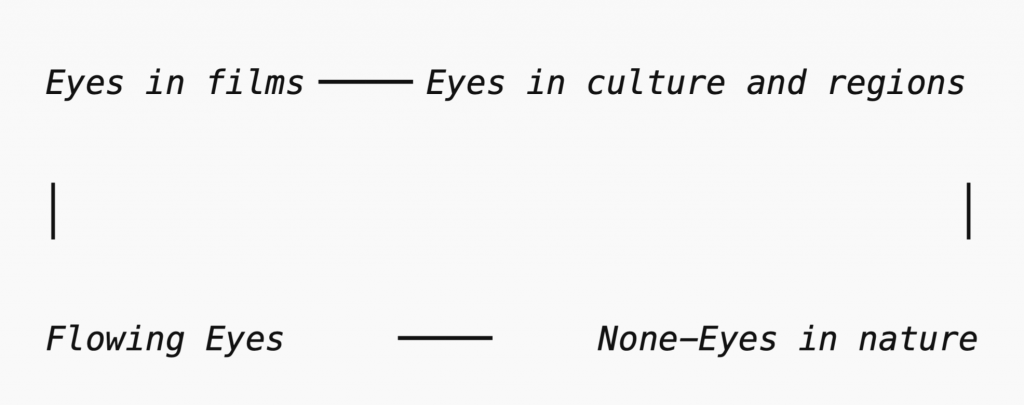
Eyes in films
In the same way that puppets are patterned and modeled into a certain social role or a certain personality, characters in films are also designed and framed according to the plot or the message that needs to be conveyed. The patterned roles and stereotypical portrayals of a certain group of people, are questioning that whether it is possible to challenge this patterned face with fluid definitions or not?
Eyes in cultures and regions
In my research on puppet styles, I have found that similar local aesthetic styles have shaped and stylised puppets from different regions and cultures, and many books have been categorised in this disciplines.
But reference of Anderson’s books (2006, p. 182), “the census, the map and the museum illuminate the latecolonial state’s style of thinking about its domain. The ‘warp’ of this thinking was a totalizingclassificatory grid, which could be applied with endless flexibility to anything under the state’real or contemplated control: peoples, regions, religions, languages, products, monuments, and so forth, The effect of the grid was always to be able to say of anything that it was this, not that; it belonged xhere, not there. It was bounded, determinate, and therefore – in principle- countable.” When searching for cultures’ pictures, distinct and highly stylized faces often appear. When these images are collected, they represent the definitions and subjective selections made by photographers, cultural promotion organizations, and collectors about the culture.When a region and culture are defined with their specific and distinctive styles and labelled as localised and nationalised, it becomes, instead, a form of standardization and definition. Is it possible to challenge this patterned face with a fluid definition?
Non-eyes in nature
The eyes of the puppets are simulated, but also showing that they possess a life-like quality, which reminds me of the eye-like patterns that many creatures in nature have (butterflies, beetles, fish, etc). These patterns, which are believed to repel predators, are natural selection’s definition of an eye but at the same time are different and varied. I reset the definition of fluid with the definition of nature, in hope that it will lead to more connections and imaginations.
Leave a Reply